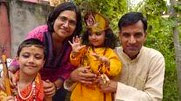
For Nepali women, motherhood is both a source of agency and subjugation. It is a source of agency because as it is only through status of a mother, specially that of son, a Nepali women can enjoy a higher status in her family and society. I am speaking from vantage point of middle class upper caste women like myself, based on my personal experience and observations. This may not be true for every other Nepali women.
How far Nepali women have a choice when to become mothers or be mothers at all? There is very little choice. It is because motherhood is so much seen as an ultimate fulfillment of femininity. Every women is somehow considered a natural mother. It is regarded as an ultimate goal for every woman. Looking at motherhood as an individual like myself, it is full of contradictions. The first contradiction on general belief of motherhood is that it is natural. It is regarded that every woman when given birth to child, acquires the art and craft of motherhood. However, motherhood is learnt by social behavior, norms, values and also the generational knowledge handed over by previous generation. Reflecting on my own journey towards motherhood I see that it is a life long course which I have partly learnt through my mother's lessons, friends counsel, neighbour's heresay, mass-media, literature and to some extent my own lived and embodied experience. Thus, I claim that I am not a natural mother, I have learnt to become a mother.
Another contradictions which I have faced constantly due to my life choices is belief in 'intensive motherhood'. Intensive motherhood ideology preaches that only mothers are the best persons to look after their children. It believes that mothers should be available to children all the time especially in their early years. The lack of that will consequently lead to serious psychological effects on child. This is a sensitive topic for me to dwell on. My decision to come to Melbourne for further studies led me to leave my 18 months old son in my parent's care. Several times, I have been branded as 'over ambitious' and 'career oriented' and sometimes even cruel. I was caught in between my ambition and motherhood. I knew that opportunity does not knock the door twice. I was in crossroads of my career which was again mediated by my motherhood. After I became mother, I chose to work only when I could. Thus, I saw myself being stagnant in my career for couple of years. Thus, I either had to choose this or be prepared to be stagnant for some other years to come.
Another big factor in motherhood of Nepali women is son vs daughter debate. Recently I had got hold of Chinese calendar which gives a list of best year and month to conceive daughter or son. Some of my friends had used it and become successful to bear son, they never tried it for a daughter. I sometimes hear that ' It is women themselves who want to bear son'. I say, they do because we have to look at how women with daughters only are treated. I remember one of my friend whose first born was daughter. Her husband was only son in the family. She was afraid that her husband will be marrying another woman if she does not bear him son. That is why, Nepali women, even so called educated career oriented women sometimes opt to have a son rather than daughter. However, there is some other debate going on which argues that ' daughter are much better than son, as son leave their home anyway these days' . One of the main reason for son preference in Nepal is our tendency to see them as our insurance for old days. The present trend shows that this belief is gradually crumbling down. I wish that Nepal abolishes its heir system in which only sons can inherit parental property. It is an irony that parents work hard to earn property which ultimately passes over to their sons. It will take a long time when ultimately Nepal could have a will system of inheritance.
Thus, there is a long way to go for Nepali women in having agency in their motherhood. It is still debated whether one needs to become mother at all to be fulfilled. There are women like Mother Teresa who choose to remain barren but became mother of millions of improvised children. It is
Showing posts with label Nepali women. Show all posts
Showing posts with label Nepali women. Show all posts
Monday, May 18, 2009
Friday, May 8, 2009
Me and my mother
Sometimes, I just wonder how I have let life slip through my fingers. Am I indulging myself too much. Should I be more duty conscious? Should I be more responsible. But again, these are such ambiguous terms. Especially these all lamentations come, when I see my role as a mother. I am a mother, who is so different from my own mother. My mother, whose sole purpose in life was to look after her husband and children. sometimes she tells me, ' oh, life is so easy for you girls today. You no longer have to do chores like we used to. You don't have strict mother-in-law like me'.
When I compare my life with my mother, I see times have indeed changed. She is one driving force behind this change. Everytime when I wanted to enter the kitchen to cook something or just fool around, she would say' I could not study, I have nothing else to do apart from this. You have to study, so that you will not end up like me'. She always encouraged me to be something. Apart from other mothers of my friends, she never was interested for finding good husband for me. but rather she beleived that I should be financially independent. My father was a patriarch in true sense. He controlled me, but in such a way that I reach my goals. I make the best of what I could do. I still remember, almost a decade ago, he called me for a serious meeting. I was about to graduate then. He asked ' what do you want in you life. If you want to marry and have kids and be housewife, now is the time for that. But, if you want to study more and make a career, you could do that. But you have to be ready to accept that you may not find a good husband. As you know that in Nepal, men don't want to get married with women who are more educated or career oriented than them'. I said, what my father wanted me to say and knew that I would say:' I choose career'.
Thus, now, I am in this lop sided balance of motherhood and career, which is not vs but somehow complements each other. It is a difficult balance that many women choose or forced to choose. Just few weeks ago, I read buchi emecheta's ' Joys of motherhood'. The first book I ever read that discussed about the daily lives of black women. The central character in the book had to become mother to be accepted as a woman. But again, sometimes her motherhood became a chain that she could not break free from. At the end, struggling through out her life for her children, she dies. But none of her children are able to look after her in her most difficult old age. She dies, alone. But then, her sons perform the most expensive funeral ever. What is the point?
The blog post, does not make sense even to me. It is a series of uncordinated ideas, which has been happening a lot while I write thesis. I come to blog, when I just want to write and not being cared about providing a good argument. It is my friend, who would listen, even if i have the most silliest thing to say. I am happy for discovering this outlet
Friday, March 20, 2009
Empowerment and subjugation
Its time I slept anyway, but there is this thought in back of my mind and i wanted to make good use of it. Yesterday I had attend women's meeting in monash and I started talking a lot about Nepali women's issues and problems. Everyone was interested and wanted to learn more about that. I talked about domestic violence, women's trafficking, sexual violence and lot other issues and problems that Nepali women face, and I got an impression, or perhaps created an impression that all nepali women are subjugated, dominated and lacking of agency.
Then, I wonder whether I am turning into someone who by depicting other's owe makes a living for herself. It has always been trend that us 'western-educated' academics, professionals make out a living by 'selling' poverty and misery of people of our country.
I just need to strongly be aware that every time I talk about Nepali women, I should also talk about success stories, some women who have found empowerment, agency within structures that has hold them down: angur baba joshi, sapana pradhan malla, ram kumari jhankri, mandira sharma. Women, who have risen above their every day life and personal problems and done something really remarkable for nepali women over all. I have not been able to be one of these examples, but the best I can hope is at least I need to make it clear that I did get opportunities to be what I am today. My parents controlled me but they never discouraged me to have career. My husband has certain ideas, but I would not be where I am today without his support. So, even in a patriarchal society, there is some space, some opportunity for agency, for empowerment
Its time I slept anyway, but there is this thought in back of my mind and i wanted to make good use of it. Yesterday I had attend women's meeting in monash and I started talking a lot about Nepali women's issues and problems. Everyone was interested and wanted to learn more about that. I talked about domestic violence, women's trafficking, sexual violence and lot other issues and problems that Nepali women face, and I got an impression, or perhaps created an impression that all nepali women are subjugated, dominated and lacking of agency.
Then, I wonder whether I am turning into someone who by depicting other's owe makes a living for herself. It has always been trend that us 'western-educated' academics, professionals make out a living by 'selling' poverty and misery of people of our country.
I just need to strongly be aware that every time I talk about Nepali women, I should also talk about success stories, some women who have found empowerment, agency within structures that has hold them down: angur baba joshi, sapana pradhan malla, ram kumari jhankri, mandira sharma. Women, who have risen above their every day life and personal problems and done something really remarkable for nepali women over all. I have not been able to be one of these examples, but the best I can hope is at least I need to make it clear that I did get opportunities to be what I am today. My parents controlled me but they never discouraged me to have career. My husband has certain ideas, but I would not be where I am today without his support. So, even in a patriarchal society, there is some space, some opportunity for agency, for empowerment

Subscribe to:
Posts (Atom)